- HR Insights Today
- Posts
- 📊 16% of employees admit faking AI use as pressure to adopt tools rises
📊 16% of employees admit faking AI use as pressure to adopt tools rises

Sophia Bennett
April 21, 2026

Presented by
Hey HR Pros!
AI adoption is creating a new kind of performance signal in the workplace, and a new term is emerging alongside it: tokenmaxxing. As employees race to demonstrate AI usage, activity metrics like prompts and token consumption are starting to influence how performance is perceived, even when they do not reflect real outcomes.
This is introducing risk for organizations trying to scale AI effectively, as employees may prioritize visible usage over meaningful impact.
Coming Up:
📊 56% of satisfied employees are still job hunting, signaling a retention risk for HR teams
💼 62% of US workers say their jobs make a meaningful contribution to the world
📊 16% of employees admit faking AI use as pressure to adopt tools rises
👑 Leaders have better lives but worse days, revealing hidden emotions
Your shortcut to the right HR software ⬇️
Between vendor calls, demo playback, and pricing pages that never quite line up, finding the right HRIS, ATS, or payroll platform can stretch across a whole quarter. 😮💨 A curated shortlist from someone who evaluates these vendors full-time saves most of the running around.
SSR's free HR software matching service covers HRIS, ATS, payroll, LMS, performance management, EOR, and PEO. No fees, no commitments. Just a targeted list tailored to your team's setup.
📰 Latest in HR News
Apple announces first CEO transition in 15 years as leadership era shifts
Iran war, AI erode employers’ expansion plans, data suggests
Deloitte cuts parental leave, PTO and IVF benefits for select employees
Gov. Kathy Hochul challenges businesses to deepen investments in childcare
📊 56% of satisfied employees are still job hunting, signaling a retention risk for HR teams
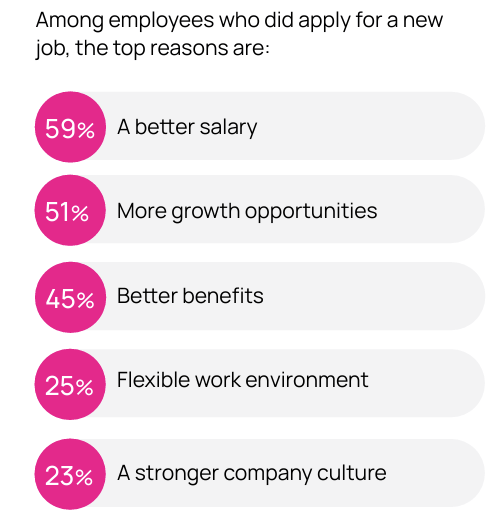
Employees report high satisfaction, stable workloads, and consistent pay increases, yet more than half are actively exploring new opportunities.
Friction in payroll, scheduling, and benefits, combined with unmet expectations for growth, is eroding loyalty even among top performers. At the same time, AI is accelerating job mobility, making it easier for employees to apply elsewhere and often.
The result is a workforce that feels content but remains highly fluid, forcing organizations to rethink how they deliver consistency, clarity, and career progression at scale.
Key insights
💼 Satisfaction isn’t retention 90% of employees report being happy, yet 56% applied for new jobs and 59% plan to apply soon
⚙️ Everyday HR friction drives exits Payroll errors and scheduling issues impact over half of employees and are top triggers for job searching
⏱️ Productivity loss is significant 47% of employees lose at least five hours weekly to inefficient systems, eroding engagement and trust
🔥 Burnout remains widespread 81% report burnout, with 68% of burned-out employees planning to explore new roles within the next year
💼 62% of US workers say their jobs make a meaningful contribution to the world
A new YouGov survey finds most American workers feel their work matters, with 62% saying their jobs make a meaningful contribution to the world and only 20% saying they do not. That is a sharp contrast to the 37% of British workers who called their jobs meaningless in a comparable 2015 poll.
The data pushes back on the narrative that modern office work has become hollow. Perceived meaning is strongly shaped by education, income, and surprisingly, by how much of the role involves email and meetings.

Key insights
Meaning is the majority view 💡 62% of US workers say their jobs make a meaningful contribution, far ahead of the minority who see their work as disconnected from broader impact
Email jobs are not meaningless jobs 📬 Workers whose roles involve some (67%) or mostly (64%) email and meetings report more meaning than those with none (53%), challenging the "email job caste" critique
Meaning and mobility are linked 🔁 Workers who view their jobs as meaningless are twice as likely (37% vs 18%) to say finding a replacement job with equivalent pay would be very hard, signaling a retention risk
Perception gaps exist across the workforce 🎓 College educated and higher income workers are more likely to describe their jobs as meaningful, suggesting engagement risk concentrates in specific employee segments
Join this session live for the chance to win a $100 gift card
Across frontline industries, the labor market has entered a new phase: fewer vacancies, slower hiring, and greater pressure on existing teams.
Drawing on insights from Deputy’s Big Shift workforce data, labor economist Dr. Shashi Karunanethy explores what this stabilization phase means for employers and HR leaders. The data reveals a surprising divide in frontline worker sentiment — with stress rising in some sectors while engagement improves in others.

📊 16% of employees admit faking AI use as pressure to adopt tools rises
Employees are increasingly equating AI usage with performance, leading to “tokenmaxxing,” where activity metrics like token consumption become proxies for productivity.
The result is a growing gap between perceived and real value, with some employees performing AI usage rather than generating outcomes.
This puts pressure on HR teams to rethink how AI adoption is encouraged, measured, and supported, especially as trust, training, and meaningful enablement lag behind executive expectations.
Poll for HR leaders
How is your organization measuring AI effectiveness today? |
Key insights
🤖 Vanity metrics are distorting AI value Token consumption and prompt volume can signal activity but fail to measure meaningful business impact
📉 Adoption pressure is driving performative behavior 16% of employees admit pretending to use AI while others feel pushed to use tools they do not understand
🧩 Training gaps are slowing real adoption Only about one quarter of organizations offer AI training, despite widespread expectations for productivity gains
⚖️ Outcome-based metrics are gaining traction Some organizations are shifting toward measuring AI through output and impact rather than raw usage data
Read the full article here: https://hrexecutive.com/from-meta-to-salesforce-will-the-tokenmaxxing-trend-go-beyond-silicon-valley/
👑 Leaders have better lives but worse days, revealing hidden emotions
New Gallup data shows leaders are more engaged at work and more likely to be thriving overall, yet they report meaningfully higher rates of stress, anger, sadness, and loneliness than the employees they manage.
The paradox is that while leadership brings status, pay, and purpose, the daily toll of high-stakes decisions, social distance from colleagues, and constant organizational change weighs heavier than most engagement metrics reveal.

Key insights
Leadership carries a hidden emotional cost 🧠 Leaders report +7pp stress, +12pp anger, +11pp sadness, and +10pp loneliness vs individual contributors, even as they show higher engagement and life satisfaction
Positive emotions are harder to access 😟 Leaders are less likely than individual contributors to say they smiled or laughed the previous day, and less likely than managers to report experiencing enjoyment
Engagement is the strongest buffer 🛡️ Engaged leaders show a 21 point gap in loneliness vs non-engaged leaders, bringing their negative emotions closer to those of individual contributors
U.S. leaders fare better with one exception 🇺🇸 In the U.S., leaders report fewer negative daily emotions than those they manage, yet stress levels still run higher than in other regions globally
Thanks for reading HR Insights Today. There’s always something changing in HR. New tools, new trends, new chaos. Not everyone to keep up with everything happening in HR so we do it for you. Each edition brings a quick, curated mix of news, resources, and learnings to help you stay updated.
BTW: This newsletter is powered by SelectSoftware Reviews. Their HR software matching service is a free resource HR pros can use to compare tools, dodge bad software, and make confident decisions (without spending hours researching). Worth checking out if you’re exploring vendors. Learn more about how it works.
How was today's edition?Rate this newsletter. |

Sophia Bennett | Editor-in-Chief | HR Insights Today