- HR Insights Today
- Posts
- The Great Hiring Freeze: Why HR’s Not Hiring—But Still Building
The Great Hiring Freeze: Why HR’s Not Hiring—But Still Building
Inside: What Japan’s Disabled Hiring Quota Can Teach Us

Sophia Bennett
September 16, 2025

Presented by
Hey HR Pros!
As hiring freezes tighten their grip, HR pros are facing a new kind of challenge: how to keep talent moving when external recruiting stalls.
In today’s edition, we dig into how organizations are navigating the “Great Stay,” what Japan’s disability hiring model can teach us about long-term inclusion, and how AI is reshaping—not replacing—talent strategy.
If your headcount is frozen, now’s the time to double down on skills, mobility, and smarter planning.
Upcoming In This Issue:
🧑💼 Making Confident HR Software Choices + How SSR Advisor Helps
🏢 New Data | Inside the The Great Hiring Freeze: Why HR’s Not Hiring—But Still Building
🎙️ Today’s Featured Podcast: How AI Will Really Impact Talent Management (Beyond the Hype)
♿ HR Learnings | Rethinking Inclusion: What Japan’s Disabled Hiring Quota Can Teach Us
📰 Latest in HR News
LinkedIn, OpenAI muscle their way into the AI recruiting fray
Klarna met with staff emoji anger over RTO policy
DEI and HR leaders are mad at SHRM (again)
Musk’s xAI Layoffs Suggest a Shift in Favor of Specialist Roles
🧑💼 Making Confident HR Software Choices + How SSR Advisor Helps
As thousands of HR leaders prepare for HR Tech 2025 in Las Vegas this week, the excitement of exploring new solutions comes with one challenge: choice overload.
According to Lattice’s 2026 State of People Strategy Report, one in four HR teams planning a full tech overhaul in 2026. The pressure is on to find HR tools that not only work well for you and your organization but also drive business outcomes. SSR’s free HR software matching service helps HR pros like you take what you’ve seen on the expo floor (or in your vendor research) and translate it into a curated shortlist that fits your goals and budget.

Key Insights:
🧩 Orchestration trumps automation: While automation handles tasks, orchestration coordinates AI agents to deliver business outcomes across departments—like seamless onboarding.
🧠 Financial wellness is tech’s next frontier: Nearly 80% of employees feel financial stress; the average worker spends 3.8 hours weekly on money issues at work.
🚫 Siloed systems are productivity killers: HR, IT, finance, and legal often operate in isolation—hurting both employee experience and operational efficiency.
📊 Ask better questions before you buy: Smart buyers tie every tech investment to outcomes: “What problem does this solve?” and “Does it unify, or divide?”
🏢 New Data | Inside the The Great Hiring Freeze: Why HR’s Not Hiring—But Still Building
Source: Career frameworks report
Turnover is down. Hiring is frozen. And employees are holding on tightly to their current jobs.
Instead of relying on external recruitment, HR teams are getting scrappy: reskilling their workforce, leaning into internal mobility, and using AI to guide smarter talent strategy.
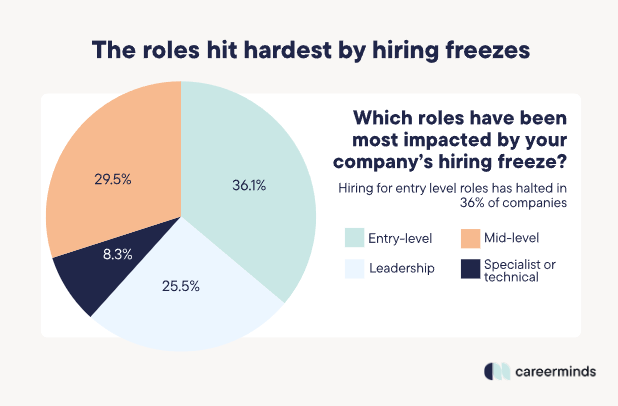
Key Insights
📉 Hiring freezes hit hard and fast: 66.7% of companies froze hiring; entry-level roles took the biggest hit, dropping 23% below pre-pandemic levels.
🧠 AI is replacing jobs—and reshaping skills: 30.6% of companies paused hiring because AI now performs roles once held by humans, forcing major reskilling.
🧍♂️ Employees are ‘job hugging’: Quit rates dropped 33%, creating internal stagnation—but also an opportunity for smart internal movement and mobility planning.
🚀 Upskilling is now strategy, not perk: 43% of HR managers are upskilling workers; 46% focus on AI skills, while 35.5% prioritize people management.
😄 Comic Relief (HR Edition)

🎙️ Today’s Featured Podcast: How AI Will Really Impact Talent Management (Beyond the Hype)
Duration: 22 minutes
Key takeaway: It’s not humans vs. machines—it’s humans with machines, doing better work together.
♿ HR Learnings | Rethinking Inclusion: What Japan’s Disabled Hiring Quota Can Teach Us
Employment quotas aren’t usually seen as innovation—but in Japan, they’ve become a powerful tool for inclusion.
By mandating that companies hire a minimum percentage of workers with disabilities, the country has built a decades-long system that boosts accessibility and opportunity for those often left out.

Key Insights
📈 21 years of steady gains: Japan hit an all-time high of 677,461 disabled workers employed in 2024—growing every year for over two decades.
⚖️ Quota climbing to 2.7%: Starting July 2026, Japanese companies must ensure 2.7% of their workforce includes people with disabilities—or face financial penalties.
🏢 Accessibility gap still lingers: Many employers limit disabled workers to peripheral roles to avoid making office-wide accessibility upgrades.
🛠️ Assistive tech + inclusive hiring = future ready: A mix of job boards, nonprofits, and assistive tools are making it easier to connect talent with opportunity—globally.
Thanks for reading HR Insights Today. There’s always something changing in HR. New tools, new trends, new chaos. Not everyone has time to keep up with everything happening in HR—so we do it for you. Each edition brings a quick, curated mix of news, resources, and learnings to help you stay updated.
BTW: This newsletter is powered by SelectSoftware Reviews. Their HR software matching service is a free resource HR pros can use to compare tools, dodge bad software, and make confident decisions (without spending hours researching). Worth checking out if you’re exploring vendors. Learn more about it here.
How was today's edition?Rate this newsletter. |

Sophia Bennett | Editor-in-Chief | HR Insights Today